दिलेले आहे:
मुद्दल (P) = ₹3,000
व्याजदर (R) = वार्षिक 6%
मुदत (T) = 9 फेब्रुवारी 2024 ते 10 एप्रिल 2024 दरम्यान
वापरलेले सूत्र:
सरळव्याज (SI) = \( \dfrac{P \times R \times T}{100} \)
गणना:
मुदत (T) = 9 फेब्रुवारी 2024 ते 10 एप्रिल 2024 दरम्यान एकूण दिवस
फेब्रुवारी 2024 = 29 दिवस (लीप वर्ष), उर्वरित दिवस = 29 - 9 + 1 = 21
मार्च 2024 = 31 दिवस
एप्रिल 2024 = 10 दिवस
⇒ एकूण दिवस = 21 + 31 + 10 = 62 दिवस
2024 हे लीप वर्ष असल्याने, वर्षात 366 दिवस आहेत.
⇒ वर्षांमधील वेळ = \( \dfrac{62}{366} \)
सरळव्याज = \( \dfrac{3000 \times 6 \times \dfrac{62}{366}}{100} \)
⇒ सरळव्याज = \( \dfrac{3000 \times 6 \times 62}{366 \times 100} \)
⇒ सरळव्याज = \( \dfrac{1116000}{36600} \)
⇒ सरळव्याज ≈ 30.49
∴ सरळव्याज अंदाजे ₹30 आहे.
Shortcut Trick
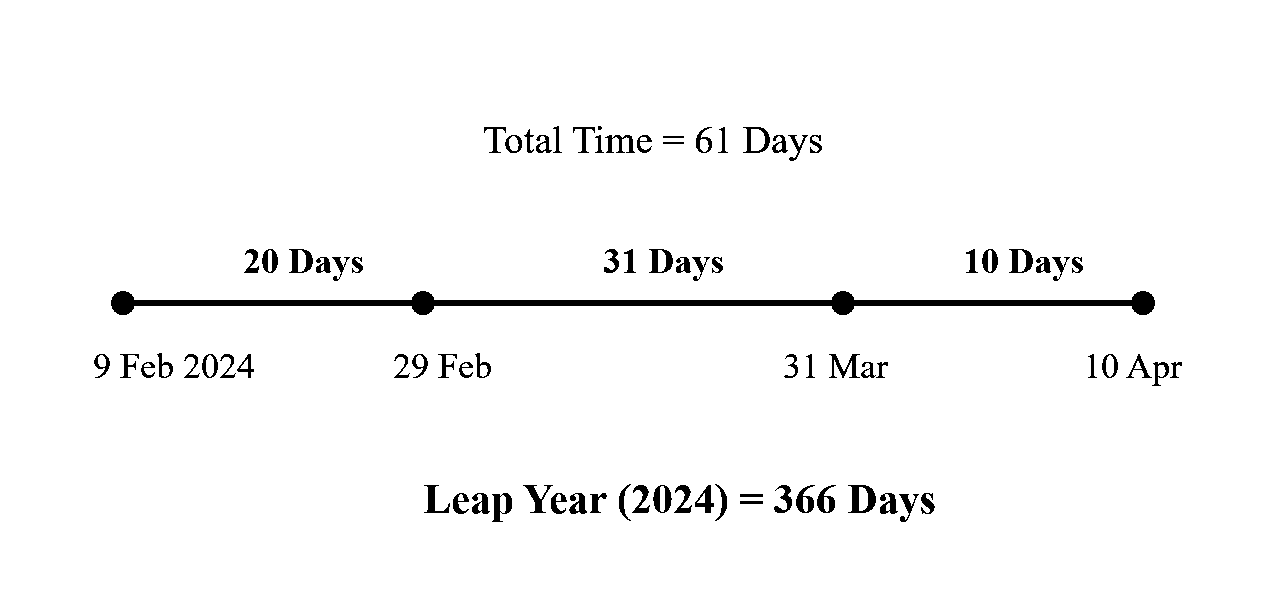
Identify Leap Year: 2024 is a leap year (366 days).
Total days = 20 (Feb) + 31 (Mar) + 10 (Apr) = 61 days.
Interest Calculation: Interest = (3000 × 6 × 61/366) / 100
Since 6 × 61 = 366, Interest = 3000 / 100 = 30.
∴ The correct answer is ₹30.
Alternate Method
Given:
Principal (P) = ₹3,000
Rate (R) = 6% per annum
Time period = 9 February 2024 to 10 April 2024
Formula Used:
Simple Interest (SI) = (P × R × T) / 100
Calculations:
⇒ Number of days in February = 29 − 9 = 20 days (2024 is a leap year)
⇒ Number of days in March = 31 days
⇒ Number of days in April = 10 days
⇒ Total Days = 20 + 31 + 10 = 61 days
⇒ Time (T) in years = 61 / 366 years
⇒ SI = (3000 × 6 × (61/366)) / 100
⇒ SI = (3000 × 6 × 61) / (100 × 366)
⇒ SI = (3000 × 366) / (100 × 366)
⇒ SI = 3000 / 100
⇒ SI = ₹30
∴ The correct answer is ₹30.
Related Concepts:
Leap Year Calculation
A year is a leap year if it is divisible by 4. If it is a century year (ending in 00), it must be divisible by 400. Leap years have 366 days.
Day Counting Rule
In banking and financial interest calculations, normally the day of deposit is excluded and the day of withdrawal is included (or vice versa).
Simple Interest vs Compound Interest
Simple interest is calculated only on the principal, while compound interest is calculated on the principal plus accumulated interest from previous periods.
परीक्षेतील संभाव्य चूक: विद्यार्थी अनेकदा पर्याय 3 ('28') आणि पर्याय 2 ('30') यामध्ये गोंधळात पडतात. प्रश्न नीट वाचून संकल्पनेतील सूक्ष्म भेद लक्षात घेणे आवश्यक आहे.
Exam Trap: Candidates frequently confuse Option 3 ('28') with Option 2 ('30'). Distinguish the exact context before marking.
शॉर्टकट ट्रिक: सूत्र व प्रत्यक्ष पडताळणी — या प्रश्नात पारंपरिक पद्धतीऐवजी पर्याय क्रमांक 2 ('30') ठेवून थेट पडताळणी केल्यास वेळेची बचत होते.
Speed Math Shortcut: Plug-in & Verify — Substitute Option 2 ('30') directly into the given conditions to solve in under 45 seconds.
🎯 पर्याय बाद पद्धत (Option Elimination Strategy):
• पर्याय 1 ('31'): हा पर्याय अयोग्य आहे. आयोगाच्या संदर्भानुसार अचूक उत्तर '30' हे ठरते.
• पर्याय 3 ('28'): हा पर्याय अयोग्य आहे. आयोगाच्या संदर्भानुसार अचूक उत्तर '30' हे ठरते.
• पर्याय 4 ('29'): हा पर्याय अयोग्य आहे. आयोगाच्या संदर्भानुसार अचूक उत्तर '30' हे ठरते.
• निष्कर्ष: त्यामुळे उर्वरित पर्याय बाद होऊन अचूक उत्तर पर्याय 2 ('30') निश्चित होते.
🎯 Option Elimination Strategy:
• Option 1 ('31'): Incorrect. As per official verified records, '30' is the valid fact.
• Option 3 ('28'): Incorrect. As per official verified records, '30' is the valid fact.
• Option 4 ('29'): Incorrect. As per official verified records, '30' is the valid fact.
• Conclusion: Hence, eliminating incorrect options leads to Option 2 ('30').