दिलेले आहे:
द्रव x च्या 1 लिटरचे वजन = 900 ग्रॅम
द्रव y च्या 1 लिटरचे वजन = 750 ग्रॅम
मिश्रणाच्या 1 लिटरचे वजन = 800 ग्रॅम
वापरलेले सूत्र:
समजा, मिश्रणातील द्रव x चे प्रमाण V_(x) आणि द्रव y चे प्रमाण V_(y) आहे.
एकूण प्रमाण (V) = V_(x) + V_(y) = 1 लिटर
मिश्रणाचे वजन = V_(x) × 900 + V_(y) × 750
मिश्रणाचे वजन 800 ग्रॅम दिलेले असल्याने, आपण समीकरण तयार करू शकतो:
800 = V_(x) × 900 + V_(y) × 750
जसे V_(x) + V_(y) = 1 असल्याने, आपण V_(y) = 1 - V_(x) हे समीकरणात ठेवू शकतो.
गणना:
800 = Vx × 900 + (1 - Vx) × 750
⇒ 800 = Vx × 900 + 750 - Vx × 750
⇒ 800 = Vx × 150 + 750
⇒ 800 - 750 = Vx × 150
⇒ 50 = Vx × 150
⇒ Vx = 50 / 150
⇒ Vx = 1/3
मिश्रणातील x ची टक्केवारी = (1/3) × 100 = 33.33%
∴ पर्याय (2) योग्य आहे.
Shortcut Trick
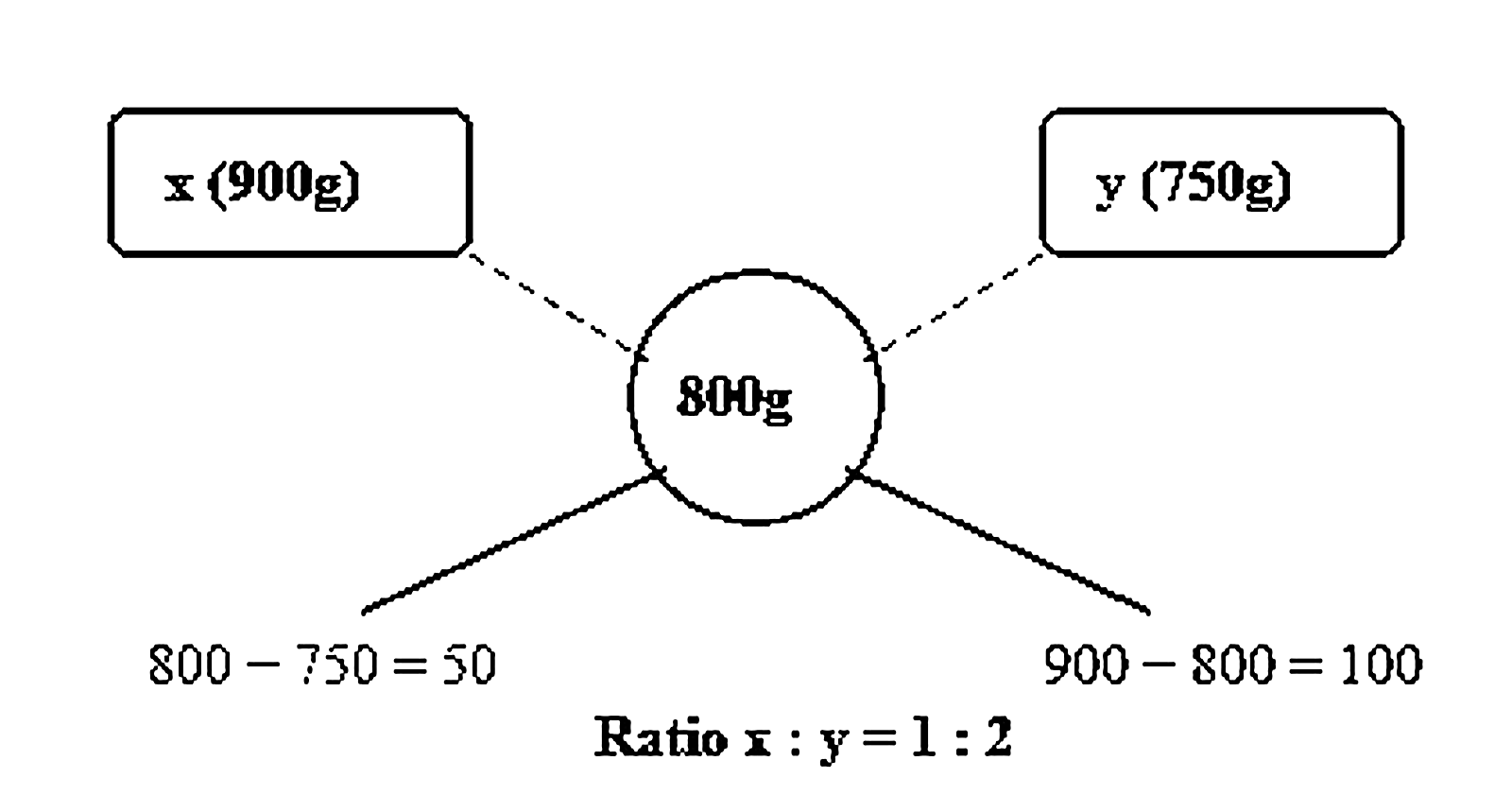
Apply the Alligation Rule to find the ratio of Liquid x and Liquid y.
Ratio of x : y = (Mean Weight − Weight of y) : (Weight of x − Mean Weight)
Ratio = (800 − 750) : (900 − 800) = 50 : 100 = 1 : 2
Percentage of x in mixture = (1 ÷ (1 + 2)) × 100 = 1/3 × 100 = 33 ^(1)/_(3) %.
∴ The correct answer is 33 ^(1)/_(3) %.
Alternate Method
Given:
Weight of Liquid x = 900 g/L
Weight of Liquid y = 750 g/L
Weight of Mixture = 800 g/L
Formula Used:
Weighted Mean = (w_(1) × x_(1) + w_(2) × x_(2)) ÷ (w_(1) + w_(2))
Calculations:
⇒ Let the volume of Liquid x be V_(x) and Liquid y be V_(y).
⇒ (900 × V_(x) + 750 × V_(y)) ÷ (V_(x) + V_(y)) = 800
⇒ 900V_(x) + 750V_(y) = 800V_(x) + 800V_(y)
⇒ 900V_(x) − 800V_(x) = 800V_(y) − 750V_(y)
⇒ 100V_(x) = 50V_(y)
⇒ V_(x) / V_(y) = 50 / 100 = 1 / 2
⇒ Percentage of Liquid x = [V_(x) / (V_(x) + V_(y))] × 100
⇒ Percentage of Liquid x = [1 / (1 + 2)] × 100 = 100 / 3 = 33 ^(1)/_(3) %
∴ The correct answer is 33 ^(1)/_(3) %.
Related Concepts:
Alligation Method
A rule used to find the ratio in which two or more ingredients at their respective prices/weights must be mixed to produce a mixture at a specific price/weight.
Percentage of Component
If the ratio of two components is a:b, the percentage of the first component is [a / (a + b)] × 100.
Common Fraction to Percentage
1/2 = 50%, 1/3 = 33 ^(1)/_(3) %, 1/4 = 25%, 1/5 = 20%.
परीक्षेतील संभाव्य चूक: विद्यार्थी अनेकदा पर्याय 3 ('50%') आणि पर्याय 2 ('\(33 \frac{1}{3} \%\)') यामध्ये गोंधळात पडतात. प्रश्न नीट वाचून संकल्पनेतील सूक्ष्म भेद लक्षात घेणे आवश्यक आहे.
Exam Trap: Candidates frequently confuse Option 3 ('50%') with Option 2 ('\(33 \frac{1}{3} \%\)'). Distinguish the exact context before marking.
शॉर्टकट ट्रिक: सूत्र व प्रत्यक्ष पडताळणी — या प्रश्नात पारंपरिक पद्धतीऐवजी पर्याय क्रमांक 2 ('\(33 \frac{1}{3} \%\)') ठेवून थेट पडताळणी केल्यास वेळेची बचत होते.
Speed Math Shortcut: Plug-in & Verify — Substitute Option 2 ('\(33 \frac{1}{3} \%\)') directly into the given conditions to solve in under 45 seconds.
🎯 पर्याय बाद पद्धत (Option Elimination Strategy):
• पर्याय 1 ('30%'): हा पर्याय अयोग्य आहे. आयोगाच्या संदर्भानुसार अचूक उत्तर '\(33 \frac{1}{3} \%\)' हे ठरते.
• पर्याय 3 ('50%'): हा पर्याय अयोग्य आहे. आयोगाच्या संदर्भानुसार अचूक उत्तर '\(33 \frac{1}{3} \%\)' हे ठरते.
• पर्याय 4 ('\(27 \frac{1}{2} \%\)'): हा पर्याय अयोग्य आहे. आयोगाच्या संदर्भानुसार अचूक उत्तर '\(33 \frac{1}{3} \%\)' हे ठरते.
• निष्कर्ष: त्यामुळे उर्वरित पर्याय बाद होऊन अचूक उत्तर पर्याय 2 ('\(33 \frac{1}{3} \%\)') निश्चित होते.
🎯 Option Elimination Strategy:
• Option 1 ('30%'): Incorrect. As per official verified records, '\(33 \frac{1}{3} \%\)' is the valid fact.
• Option 3 ('50%'): Incorrect. As per official verified records, '\(33 \frac{1}{3} \%\)' is the valid fact.
• Option 4 ('\(27 \frac{1}{2} \%\)'): Incorrect. As per official verified records, '\(33 \frac{1}{3} \%\)' is the valid fact.
• Conclusion: Hence, eliminating incorrect options leads to Option 2 ('\(33 \frac{1}{3} \%\)').