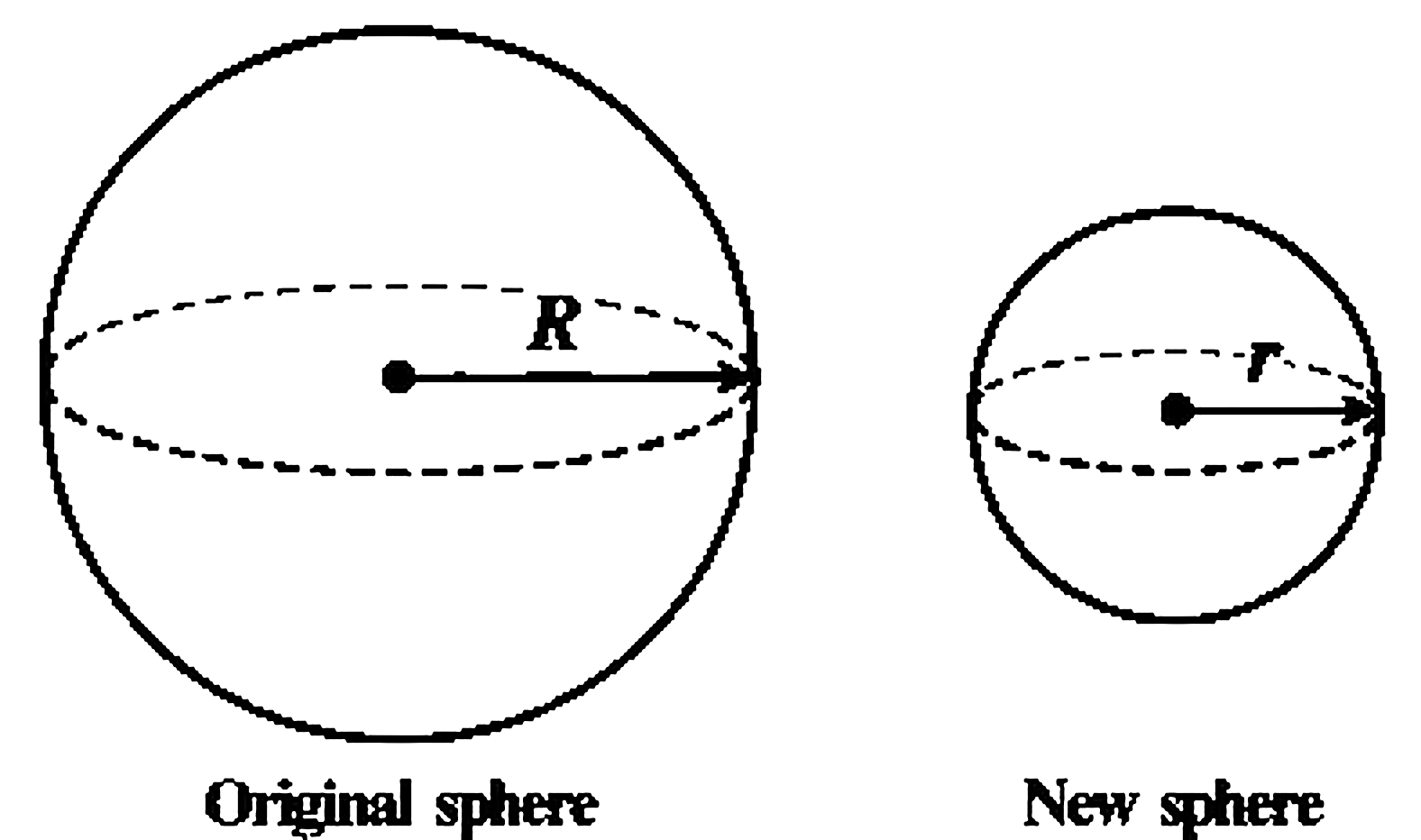
दिलेले:
गोलाची सुरुवातीची त्रिज्या = r.
त्रिज्या 90% ने कमी झाली, म्हणून नवीन त्रिज्या = r च्या 20% = 0.2r
वापरलेले सूत्र:
गोलाचे आकारमान = \(\left(\frac{4}{3}\right) \pi r^3\)
गणना:
सुरुवातीचा आकारमान, \(V_{initial} = \left(\frac{4}{3}\right) \pi r^3\)
नवीन खंड, \(V_{new} = \left(\frac{4}{3}\right) \pi (0.2r)^3\)
⇒ \(V_{new} = \left(\frac{4}{3}\right) \pi (0.008r^3)\)
⇒ \(V_{new} = 0.008 \left(\frac{4}{3}\right) \pi r^3\)
⇒ \(V_{new} = 0.008 V_{initial}\)
आवाज कमी होणे = \(V_{initial} - V_{new}\)
⇒ आवाजात घट = \(V_{initial} - 0.008 V_{initial}\)
⇒ आवाजात घट = \(0.992 V_{initial}\)
आकारमानातील टक्केवारी घट = \(\left(\frac{Decrease \, in \, volume}{Initial \, volume}\right) × 100\)
⇒ आकारमानातील टक्केवारी घट = \(\left(\frac{0.992 V_{initial}}{V_{initial}}\right) × 100\)
⇒ आकारमानातील टक्केवारी घट = 0.992 × 100
⇒ आकारमानातील टक्केवारी घट = 99.2%
गोलाचे आकारमान 99.2% ने कमी होईल.
Shortcut Trick
Radius ratio (Initial : New) = 100 : (100 − 80) = 100 : 20 = 5 : 1.
Since Volume of a sphere is proportional to the cube of its radius (V ∝ r^(3)):
Volume ratio = 5^(3) : 1^(3) = 125 : 1.
Reduction in volume = 125 − 1 = 124 units.
Percentage decrease = (Decrease ÷ Initial Volume) × 100 = (124 ÷ 125) × 100 = 99.2%.
∴ The correct answer is 99.2 percent.
Alternate Method
Given: The radius of the sphere is decreased by 80%.
Calculations:-
Radius of sphere is decreased by 80%.
So, new radius = 20% of original radius = 0.2r
Volume of sphere is proportional to the cube of its radius.
Original volume ∝ r³
New volume ∝ (0.2r)³
= 0.008r³
Therefore,
New volume = 0.008 × Original volume
Percentage decrease:
= (1 − 0.008) × 100
= 0.992 × 100
= 99.2%
The volume of the sphere will be decreased by 99.2%.
Related Concepts:
Volume of a Sphere
The amount of space occupied by a 3D sphere is given by V = (4/3)πr^(3), where r is the radius.
Surface Area of a Sphere
The total surface area of a sphere is given by A = 4πr^(2). If radius decreases by 80%, area decreases by 96%.
Successive Percentage Rule
For volume changes, the percentage change can be calculated using successive effective rates three times: x + y + (xy/100).
Ratio and Powers
If a linear dimension changes by ratio a:b, then Area changes by a^(2):b^(2) and Volume changes by a^(3):b^(3).
परीक्षेतील संभाव्य चूक: विद्यार्थी अनेकदा पर्याय 3 ('94.2 टक्के') आणि पर्याय 2 ('99.2 टक्के') यामध्ये गोंधळात पडतात. प्रश्न नीट वाचून संकल्पनेतील सूक्ष्म भेद लक्षात घेणे आवश्यक आहे.
Exam Trap: Candidates frequently confuse Option 3 ('94.2 percent') with Option 2 ('99.2 percent'). Distinguish the exact context before marking.
शॉर्टकट ट्रिक: सूत्र व प्रत्यक्ष पडताळणी — या प्रश्नात पारंपरिक पद्धतीऐवजी पर्याय क्रमांक 2 ('99.2 टक्के') ठेवून थेट पडताळणी केल्यास वेळेची बचत होते.
Speed Math Shortcut: Plug-in & Verify — Substitute Option 2 ('99.2 percent') directly into the given conditions to solve in under 45 seconds.
🎯 पर्याय बाद पद्धत (Option Elimination Strategy):
• पर्याय 1 ('98.2 टक्के'): हा पर्याय अयोग्य आहे. आयोगाच्या संदर्भानुसार अचूक उत्तर '99.2 टक्के' हे ठरते.
• पर्याय 3 ('94.2 टक्के'): हा पर्याय अयोग्य आहे. आयोगाच्या संदर्भानुसार अचूक उत्तर '99.2 टक्के' हे ठरते.
• पर्याय 4 ('95.2 टक्के'): हा पर्याय अयोग्य आहे. आयोगाच्या संदर्भानुसार अचूक उत्तर '99.2 टक्के' हे ठरते.
• निष्कर्ष: त्यामुळे उर्वरित पर्याय बाद होऊन अचूक उत्तर पर्याय 2 ('99.2 टक्के') निश्चित होते.
🎯 Option Elimination Strategy:
• Option 1 ('98.2 percent'): Incorrect. As per official verified records, '99.2 percent' is the valid fact.
• Option 3 ('94.2 percent'): Incorrect. As per official verified records, '99.2 percent' is the valid fact.
• Option 4 ('95.2 percent'): Incorrect. As per official verified records, '99.2 percent' is the valid fact.
• Conclusion: Hence, eliminating incorrect options leads to Option 2 ('99.2 percent').