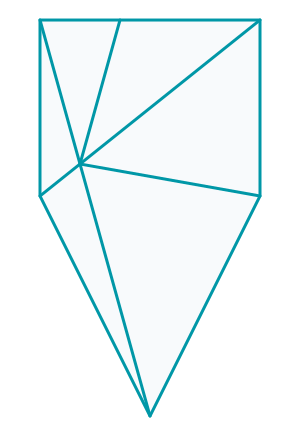
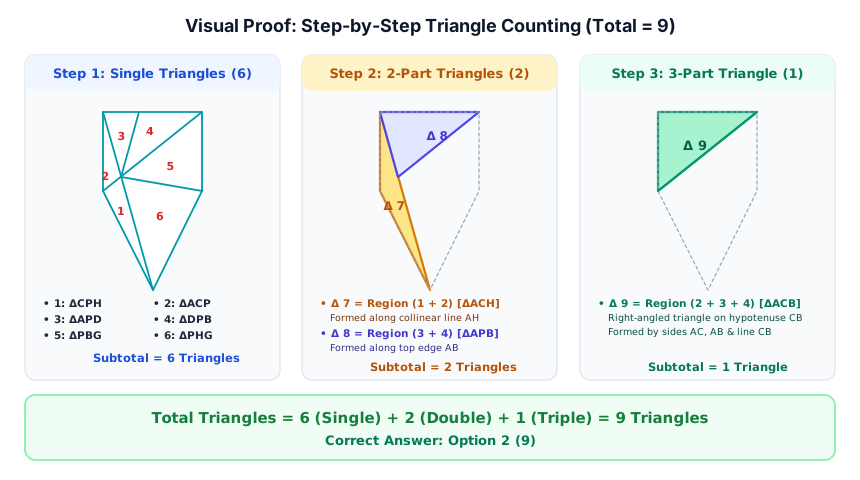
दिलेल्या आकृतीतील त्रिकोणांची अचूक मोजणी करण्यासाठी अंतर्गत छेदनबिंदू $P$ पासून तयार होणारे सुटे भाग आणि सरळ रेषांवरून तयार होणारे संयुक्त भाग मोजू:
१. सुटे (१-घटक) त्रिकोण (६):
- त्रिकोण १ = $\Delta CPH$
- त्रिकोण २ = $\Delta ACP$
- त्रिकोण ३ = $\Delta APD$
- त्रिकोण ४ = $\Delta DPB$
- त्रिकोण ५ = $\Delta PBG$
- त्रिकोण ६ = $\Delta PHG$
$$\text{सुटे त्रिकोण} = ६$$
२. दोन घटकांचे मध्यम त्रिकोण (२):
- त्रिकोण ७ = भाग $(१ + २) = \Delta ACH$ (बिंदू $A, P, H$ एकाच सरळ कर्णावर असल्याने तयार होणारा त्रिकोण).
- त्रिकोण ८ = भाग $(३ + ४) = \Delta APB$ (वरची बाजू $AB$ सरळ असल्याने बिंदू $P$ शी जोडलेला त्रिकोण).
$$\text{दोन घटकांचे त्रिकोण} = २$$
३. तीन घटकांचा मोठा त्रिकोण (१):
- त्रिकोण ९ = भाग $(२ + ३ + ४) = \Delta ACB$ (काटकोन बाजू $AC, AB$ आणि पूर्ण कर्णरेषा $CB$ यांनी बनलेला मोठा काटकोन त्रिकोण).
$$\text{तीन घटकांचे त्रिकोण} = १$$
$$\text{एकूण त्रिकोण} = ६ \text{ (सुटे)} + २ \text{ (मध्यम)} + १ \text{ (मोठा)} = ९$$
म्हणून, अचूक उत्तर पर्याय २ (९) आहे.
To count the total number of triangles systematically, we break the polygon into single triangular sub-regions radiating from internal junction $P$ and then combine adjacent regions along collinear boundaries:
1. Single (1-Component) Triangles (6):
- $\Delta 1 = \Delta CPH$
- $\Delta 2 = \Delta ACP$
- $\Delta 3 = \Delta APD$
- $\Delta 4 = \Delta DPB$
- $\Delta 5 = \Delta PBG$
- $\Delta 6 = \Delta PHG$
$$\text{Single Triangles Count} = 6$$
2. Double (2-Component) Triangles (2):
- $\Delta 7 = \text{Region }(1 + 2) = \Delta ACH$ (formed because $A, P, H$ lie on a single continuous straight diagonal line $AH$).
- $\Delta 8 = \text{Region }(3 + 4) = \Delta APB$ (formed because $A, D, B$ lie along the single continuous top horizontal edge $AB$).
$$\text{Double Triangles Count} = 2$$
3. Triple (3-Component) Triangles (1):
- $\Delta 9 = \text{Region }(2 + 3 + 4) = \Delta ACB$ (a large right-angled triangle bounded by vertical edge $AC$, top horizontal edge $AB$, and full diagonal hypotenuse $CB$).
$$\text{Triple Triangles Count} = 1$$
$$\text{Total Triangles} = 6 \text{ (Single)} + 2 \text{ (Double)} + 1 \text{ (Triple)} = 9$$
Hence, the correct answer is Option 2 (9).
विद्यार्थी बहुधा भाग $(५ + ६)$ हा त्रिकोण समजण्याची चूक करतात; मात्र बिंदू $B, G, H$ एका सरळ रेषेत नसून $G$ जवळ कोन तयार होतो, त्यामुळे $PBGH$ हा चौकोन ठरतो. फक्त $AH$, $AB$ व $CB$ या सरळ रेषांवरच संयुक्त त्रिकोण तयार होतात.
Candidates frequently assume the composite region $(5 + 6)$ is a triangle. However, the outer boundary $B-G-H$ has a bend at vertex $G$ and is not a straight line, making $PBGH$ a 4-sided quadrilateral. Only collinear segments $AH$, $CB$, and $AB$ generate valid composite triangles.
६ सुटे + २ मध्यम (AH व AB रेषेवर) + १ मोठा काटकोन (CB रेषेवर) = ९ त्रिकोण!
6 Single + 2 Pairs (on lines AH & AB) + 1 Major (on line CB) = 9 Triangles!
- पर्याय १ (७): चुकीचा. केवळ सुटे ६ त्रिकोण मोजून संयुक्त त्रिकोणांकडे दुर्लक्ष केल्यास अशी चूक होते.
- पर्याय ३ (१०): चुकीचा. भाग $(५ + ६)$ किंवा $(१ + ६)$ यांना त्रिकोण गृहीत धरल्यास १० उत्तर येते, परंतु त्यांच्या बाहेरील कडा सरळ रेषेत नसून चौकोन तयार करतात.
- पर्याय ४ (८): चुकीचा. मोठा काटकोन त्रिकोण $\Delta ACB$ किंवा मधला एक संयुक्त त्रिकोण मोजायचा राहून गेल्यास ८ उत्तर येते.
- Option 1 (7): Incorrect. Candidates who count only the 6 individual compartments and miss two of the three composite triangles arrive at 7.
- Option 3 (10): Incorrect. Overcounts quadrilateral regions like $(5 + 6)$ or $(1 + 6)$ which lack collinear outer edges and therefore do not form triangles.
- Option 4 (8): Incorrect. Typically misses either the large right triangle $\Delta ACB$ or one of the collinear double triangles.