
Quantitative Aptitude
Simple & Compound Interest
FMT-01
पडताळलेले उत्तर (Verified)
MPSC सराव प्रश्न:
अमनकडे 10,000 रुपये होते. त्याने त्यातील काही भाग 8% वार्षिक सरळ व्याजाने आणि उर्वरित भाग 10% वार्षिक दराने कर्ज दिला. त्याचे एकूण वार्षिक उत्पन्न (व्याज) 880 रुपये असल्यास, 8% दराने दिलेली रक्कम किती?
Aman had Rs. 10,000 with him. He lent a part of it at 8% per annum simple interest and the remaining at 10% per annum. His total annual income was Rs. 880. Find the sum lent at 8%:
पर्याय (Options):
A
5,500 रुपये
B
अचूक उत्तर (Official Answer)
6,000 रुपये
C
5,000 रुपये
D
6,500 रुपये
सविस्तर स्पष्टीकरण (Detailed Explanation):
अचूक उत्तर: पर्याय (2)
१. एकूण सरासरी व्याजदर काढू:
$$\text{सरासरी दर } R = \frac{880}{10,000} \times 100 = 8.8\%$$
२. मिश्रण पद्धतीचा (Alligation) वापर:
- दर १ = $8\%$, दर २ = $10\%$, सरासरी दर = $8.8\%$
$$\text{रक्कम गुणोत्तर} = (10 - 8.8) : (8.8 - 8) = 1.2 : 0.8 = \mathbf{3 : 2}$$
३. १०,००० रुपयांची ३:२ प्रमाणात वाटणी:
$$\text{एकूण भाग} = 3 + 2 = 5$$
$$1 \text{ भाग} = \frac{10,000}{5} = 2,000\text{ रुपये}$$
$$8\% \text{ ने दिलेली रक्कम} = 3 \times 2,000 = \mathbf{6,000\text{ रुपये}}$$
$$10\% \text{ ने दिलेली रक्कम} = 2 \times 2,000 = 4,000\text{ रुपये}$$
४. पडताळा:
$$6,000 \text{ चे } 8\% = 480\text{ रुपये}$$
$$4,000 \text{ चे } 10\% = 400\text{ रुपये}$$
$$\text{एकूण व्याज} = 480 + 400 = 880\text{ रुपये (अगदी अचूक)}$$
स्पष्टीकरण आकृती (Solution Visual Diagram):
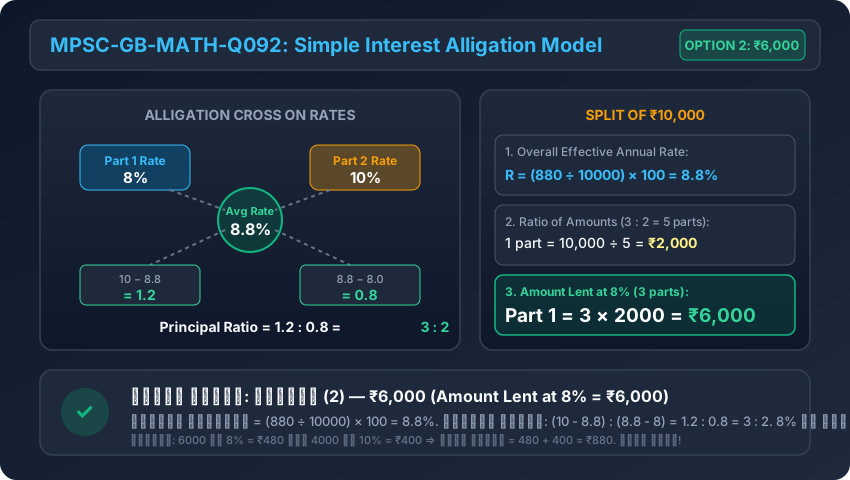


स्पष्टीकरणाची आकृती / संदर्भ तक्ता
स्पष्टीकरणाची आकृती / संदर्भ तक्ता
परीक्षेतील संभाव्य चूक / Exam Trap:
मिश्रण गुणोत्तर काढताना भागांची अदलाबदल करू नका: 8% च्या भागाचे प्रमाण 1.2 (3 भाग) आणि 10% च्या भागाचे प्रमाण 0.8 (2 भाग) येते.
स्मृती क्लृप्ती / Memory Booster & Mnemonic:
सरासरी दर = 8.8%. गुणोत्तर = $1.2 : 0.8 = 3 : 2 \implies 8\%$ रक्कम = $\frac{3}{5} \times 10,000 = \mathbf{6,000\text{ रुपये}}$!
पर्याय निर्मूलन पद्धत / Option Elimination Strategy:
१. 5,500 रुपये: व्याज 890 रु. येते (चूक). २. 6,000 रुपये: $480 + 400 = 880$ रु. अचूक मिळते (अचूक उत्तर). ३. 5,000 रुपये: व्याज 900 रु. येते (चूक). ४. 6,500 रुपये: व्याज 870 रु. येते (चूक).