
Quantitative Aptitude
Percentage, Profit, Loss & Discount
FMT-01
पडताळलेले उत्तर (Verified)
MPSC सराव प्रश्न:
साखरेच्या किंमतीत 25% वाढ झाली, तर एकूण खर्च तसाच राहण्यासाठी वापरात किती टक्के घट करावी लागेल?
If the sugar price is increased by 25%, by how much percent consumption should be reduced so that expenditure remains the same?
पर्याय (Options):
A
25%
B
अचूक उत्तर (Official Answer)
20%
C
30%
D
35%
सविस्तर स्पष्टीकरण (Detailed Explanation):
अचूक उत्तर: पर्याय (2)
१. किंमत आणि वापर यांचा व्यस्त संबंध (खर्च स्थिर असताना):
$$\text{खर्च} = \text{किंमत} \times \text{वापर}$$
समजा सुरुवातीची किंमत = 100, वापर = 100 $\implies$ खर्च = 10,000.
२. नवीन किंमत $= 100 + 25 = 125$.
खर्च 10,000 च राहण्यासाठी नवीन वापर:
$$\text{नवीन वापर} = \frac{10000}{125} = 80$$
$$\text{वापरातील घट} = 100 - 80 = \mathbf{20\%}$$
३. थेट सूत्र:
$$\text{घट \%} = \left(\frac{R}{100 + R}\right) \times 100 = \left(\frac{25}{125}\right) \times 100 = \frac{1}{5} \times 100 = \mathbf{20\%}$$
स्पष्टीकरण आकृती (Solution Visual Diagram):
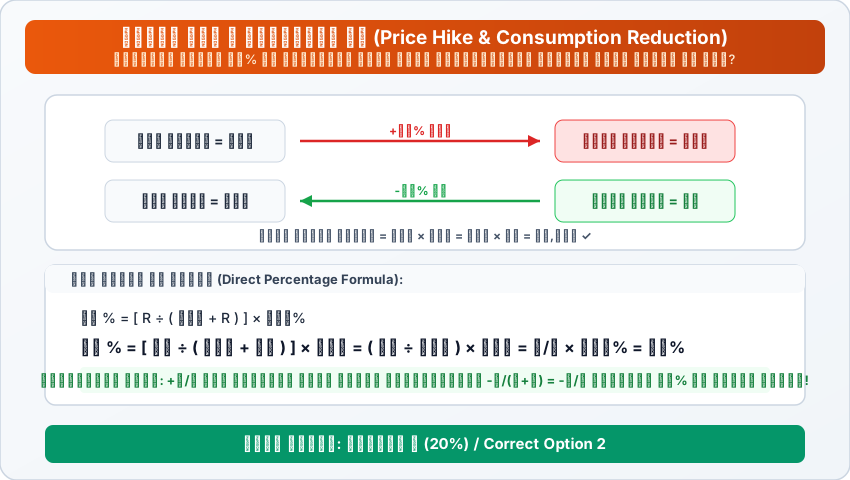

स्पष्टीकरणाची आकृती / संदर्भ तक्ता
परीक्षेतील संभाव्य चूक / Exam Trap:
विद्यार्थी अनेकदा 25% वाढीला 25% घट समजून पर्याय 1 निवडतात. घट नेहमी $\frac{R}{100+R}$ वर मोजली जाते.
स्मृती क्लृप्ती / Memory Booster & Mnemonic:
अपूर्णांक शिडी: $+\frac{1}{4}$ (25%) वाढ $\implies -\frac{1}{5}$ (20%) घट!
पर्याय निर्मूलन पद्धत / Option Elimination Strategy:
१. 25%: किंमत 25% वाढल्यास वापर 25% कमी होत नाही ($125 \times 0.75 = 93.75$). २. 20%: $125 \times 0.80 = 100$, खर्च तंतोतंत समान राहतो! ३. 30%: चुकीचा पर्याय. ४. 35%: चुकीचा पर्याय.