
Quantitative Aptitude
Number System, BODMAS & Fractions
FMT-01
पडताळलेले उत्तर (Verified)
MPSC सराव प्रश्न:
एका वर्गात 40 विद्यार्थी (फक्त मुले आणि मुली) आहेत. मुलींची संख्या ही मुलांच्या संख्येच्या तीन-सप्तमांश ($\frac{3}{7}$) आहे.<br><br><strong>तर वर्गातील मुलांची संख्या शोधा.</strong>
In a class there are 40 students (only boys and girls). The number of girls is three-sevenths ($\frac{3}{7}$) of the number of boys.<br><br><strong>Find the number of boys in the class.</strong>
पर्याय (Options):
A
अचूक उत्तर (Official Answer)
28
B
24
C
12
D
32
सविस्तर स्पष्टीकरण (Detailed Explanation):
अचूक उत्तर: पर्याय (1)
समजा वर्गातील मुलांची संख्या $B$ आणि मुलींची संख्या $G$ आहे.
दिलेल्या अटीनुसार:
$$G = \frac{3}{7}B \implies \frac{G}{B} = \frac{3}{7} \implies \text{मुले : मुली गुणोत्तर } = 7 : 3$$
एकूण गुणोत्तर एकके:
$$\text{एकूण एकके} = 7 + 3 = 10\text{ एकक}$$
एकूण विद्यार्थी = 40 असल्याने:
$$10\text{ एकक} = 40 \implies 1\text{ एकक} = 4\text{ विद्यार्थी}$$
मुलांची संख्या:
$$\text{मुलांची संख्या} = 7\text{ एकक} = 7 \times 4 = \mathbf{28\text{ मुले}}$$
(पडताळा: मुली = $3 \times 4 = 12$; एकूण = $28 + 12 = 40$).
स्पष्टीकरण आकृती (Solution Visual Diagram):
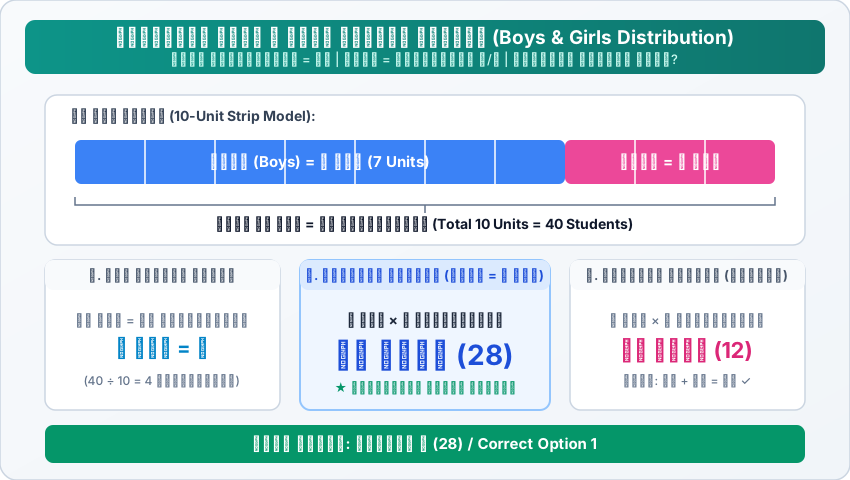

स्पष्टीकरणाची आकृती / संदर्भ तक्ता
परीक्षेतील संभाव्य चूक / Exam Trap:
मुले आणि मुली यात गल्लत करू नका: १२ ही मुलींची संख्या आहे, तर २८ ही मुलांची संख्या आहे.
स्मृती क्लृप्ती / Memory Booster & Mnemonic:
अपूर्णांकाचे गुणोत्तर: मुली मुलांच्या ३/७ म्हणजे मुले = ७ भाग, मुली = ३ भाग!
पर्याय निर्मूलन पद्धत / Option Elimination Strategy:
१. 28: अचूक उत्तर ($7 \times 4 = 28$). २. 24: चुकीचा पर्याय. ३. 12: ही मुलींची संख्या आहे ($3 \times 4 = 12$). ४. 32: चुकीचा पर्याय.